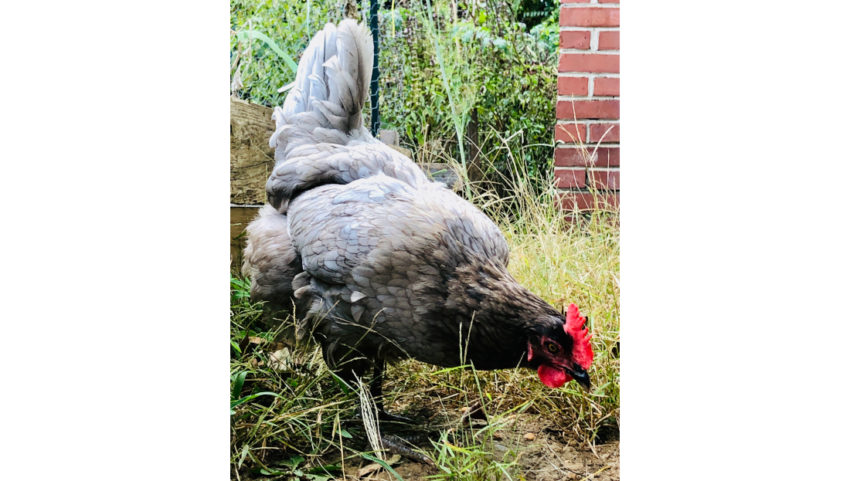
It was a late August afternoon. I was on the phone with a friend when I heard a wild cacophony of clucking and bah-gawking circling the house. I looked out the side porch and saw the silver blur of Lang dart by, and then what my eye-brain synapses decided was (taking in a big fluffy tail) a very large rodent. Cue thoughts: Why is that very large squirrel chasing Lang?
I almost left it at that. Weird squirrel. But the harried clucking continued, then suddenly stopped. Sudden stop = not a good sign. I popped out the door and jogged to the front yard (last location of harried clucking) and saw a fox facing me, with its ears up and its jaws chomped down between Lang’s wings. Then it turned tail (literally) and skittered across the road and into the impenetrable (for humans) bush. Oh fiddlesticks. Is this the end of Lang?
Lang is one of our newest brood, brought home in August 2022, and we are really just starting to get to know her. She was labelled an Easter Egger, though we think she looks a bit like a Langshan. True story: we’d never heard of the Langshan breed when we named her. Her name is an homage to the incomparable Canadian chanteuse k.d. lang. All that said, the big personalities of Brood One and Brood Two haven’t left a tonne of space for her quieter and less social (demanding) temperament—neither have the big personalities in Brood Three, come to think of it. And, here she was, maybe snatched away forever. . .
I endured a sinking-heart moment . . . and then I heard a resonant Bah-Gawk from the bushes across the road. I chose to think better of my worst-case-worries tendencies, I ended my call, and I headed toward the leg-mangling scrub. All the while, yelling—a bit like a mad woman . . . a lot like a mad woman—with the hope of startling that deadly oversized squirrel and getting my sweet platinum baby girl back.
“Get outta here fox! Drop her!”
Silence.
Me walking through thorny bushes.
[Light cursing.]
Me calling, “Laaaang-ston! Come on, sweet chickie girl.”
Silence.
Then the crunch-crunch, crunch-crunch, crunch-crunch of what sounded very distinctly like the pitter-patter of TWO little feet running my way. And out of the briars popped Lang, headed toward me with a quickness. . . and then barreling right on past me with an enduring quickness. She bulleted down the road with the clear (and unquestionably wise) intention of moving as fast as possible to get as far away as possible from the last contact point with the fox. Imagine a Roadrunner-esque sprint. Beep, beep, vrooooooom! Wiley E. Foxey, not the winner of chicken dinner tonight.
On Lang went, at top chicken pace, right on past me, down the length of the neighbours’ yard, back across the road, a short pause to *pop* herself through a chicken-sized square in another neighbours’ fence, and then straight down their driveway, like a fierce marathoner finding pace, holding it, and headed for the finish line. There’s no place like home.
And, here comes crazy chicken mom, in pursuit! Jogging down the road, calling her name, hopping the neighbours’ clearly-marked “NO TRESPASSING” cattle gate, without injury—amazing!—and catching up to Lang’s sweet and steady get away. Offering plenty of vocal reminders from above and behind, “It’s just me sweet girl. It’s going to be OK.”
Finally, she slowed. I could almost see the awareness of her knowing, Now there is enough space between me and that bad guy. I managed to collect her in my paws and carry her back to our yard.

I cradled her back home and she didn’t make single a move to get out of my arms. All the while I was trying to assess the extent of her injuries. Unable to clearly see every inch of skin through her armour of platinum-steel feathers, so smelling for chicken blood—because once you’ve smelled it, you know—and coming up without a trace.
I brought her into the house and plopped her in the ICU (Inside-the-House Chicken Unit) Minnie had just been released from. Then I stumbled back out into the yard for a high-stakes “scratch-up” of the other twelve girls—still ranging freely, though with some tentative looks and head postures. [Rennie and Hermione, you really tested Mommy that day, but she forgives you because FOX!] And when the remaining un-mauled chickens were up (and I was sweating like a chubby uncle on a Florida wedding dance floor) it was time for me to return inside and closely inspect and assess sweet Lang.
Amazingly the little girl had no puncture wounds. Apparently foxes can carry rabies, so it was nice not to have to worry about that.* She was less quite a few tail and saddle feathers, stunned and exhausted as can be, but otherwise a-OK. And, yes, Lang had a quiet, non-roosting sleep in the house that night.
*With further reading I’ve learned it is very unlikely to impossible for rabies to be transferred to chickens. Don’t take my word for it: consult animal epidemiologists for the final answer on this.
The next morning, it was clear that Lang was ready to get out. She was chatty and cranky and trying every trick in the book to pop out of ICU 1.0, which has now been (hallelujah) upgraded to ICU 2.0: a proper crate. I put Lang out with her sisters and watched a bit. She seemed OK, though when I returned a few hours later to check in, she was tail down under the hen house and very limpy on one side.
Hands and knees in dirt, doo-doo, and pebbles, I extracted Lang from under the hen house, brought her back into the human house, and managed to trick her into a sliver of low-dose aspirin, mixed in with “finch mix” where it looks just like a yummy sunflower chunk. I put her up in the ICU for a little rest and to let the medicine work. For more about chicken pain support, I found this article very helpful and (as in most matters of chicken health and well-being) we always, always, always check out way Gail Damerow and The Chicken Chick have to say about things.
Within a few hours the aspirin micro-dose must have had its effect, because Lang was chipper, protesting, and ready to get back out with her girls. I’ve mentioned this before, but plucky behaviour and protesting imposed limitations is almost always a no-brainer indicator that a chickie girl is ready to leave isolation and be returned to the flock.

That is kind of the whole tale of Lang and the fox. I think I gave her a little aspirin again the next day. Kept my eye out for eating, drinking, clucking, pooping and preening—the five fundamental characteristics of chicken health and happiness—and saw they were all present. She did limp a bit for a few days and move a bit more slowly, but overall, her return to normal was short and sweet.
I suppose the bigger question in this story is how do we definitively protect our flock from chicken predators? The short answer is we don’t. We can be hover parents when they are free-ranging (and we absolutely are!) but we still can’t watch them all at every moment. We have lost four chickie girls to predators. It doesn’t get easier. But we try to reassure ourselves that compared to the other 99.9999% of chickens on the planet, our girls have it really good—from the moment they find their way into the cardboard chickie takeaway containers to the moment they return to the flock in the great beyond. It’s unquestionable that chickens are much happier ranging than being “cooped up.” It’s a valuable risk.
There are definitely some ways we’ve minimized the potential wins for chicken predators:
- We don’t let the flock free range when we’re not home anymore—we both work from home, so this is not as bad as it sounds.
- We do have their run completely covered by light weight deer netting to prevent arial predation. Not the greatest joy to install, but it is wonderfully light weight while surprisingly strong and it’s easy to adjust or extend on.
- We do always close up the houses each night (with carabiners on all doors and hatches) as close to dusk as possible and if we are out past dark our wonderful neighbours often pop over to help out with bedtime.
- We do stick to shorter and supervised free-ranging in the winter, when the leaves are gone. We suit up and kick leaves with the girls. It’s also a fun time to dig up worms for them, which makes them happy and keeps me warm.
- And, during the leafier seasons when they are free-ranging the most we do keep our doors open (no a/c, y’all!) to keep an ear out, we also pop out from time-to-time just to check-in, and we immediately pop out and make some noise when we hear flurries of alarm clucking.
This in-and-out surveillance helped to save Lady after a red-tailed hawk attack. We also had a second fox (we think) attack on Jo-Jo, a few weeks after Lang. We heard alarm clucking and darted out to see what was up. After finding several unsettling piles of Barred Rock feathers, we found Jo-Jo and she (praise be!) recovered. . . after quite a bit of time in the ICU and a great deal of triple-antibiotic ointment—her puncture wounds were fierce.
For many, this degree of flock (micro) management would seem crazy. Fair enough. For us it sometimes seems crazy, but paradoxically choosing this approach keeps us sane. You’ll find your path and your balance with your chickie girls. You will lose a few to things other than old age. But rest assured, if you shed a few (or more) tears over the loss, that chickie girl probably lived an exceptionally special chicken life.
We’re so happy Lang scampered her way out of the fox’s sneaky little jaws. We’re happy Jo-Jo did too. How did they do it? No idea. Our pride in their wiliness remains. We haven’t been so lucky to save them all, but when we do, it’s yet another opportunity for developing chicken-care skills, gratitude, and an ever-expanding chicken first aid / recovery kit.
We lost two chickens to a carpet python during one night in October 2026, despite thinking we had every possible tiny gap secured. They were the only two chickens resident at the time, gratefully. Of course the 7 foot-long snake could not exit the chicken hut, due to its sudden growth in girth.
Our risks are mainly snakes, although Australian magpies are a risk to free-ranging chickens during magpie breeding season in Spring. They are actually a risk to humans walking, or cycling anywhere near a nesting area. I have had a magpie take a peck at my left earlobe as it flew at me from behind, drawing blood!
We have been trying to get a small flock of heritage Australorps together by purchasing fertile eggs and incubating them. Our first effort resulted in 5 cockerels (young roosters, called roos in the US I think, but roos in Australia are Kangaroos). A subsequent effort resulted in 2 cockerels and 1 pullet, who is now 19 weeks of age. Our latest effort resulted in 3 cockerels and 5 pullets, who are almost 8 weeks of age.
Whilst we live in a regional area of Queensland, which is beachside, we are still in a suburban style of living, so crowing cockerels and roosters are not really permissible long term. We have a connection with a person from a local produce market who takes unwanted cockerels/roosters of one’s hands and sells them on.
So, bottom line is that we now have 6 pullets, 1 x 19 weeks and 5 x 8 weeks. They are all free ranging for much of the day, but the older pullet herds the younger ones back into their hut, when she sees them out and about. As soon as she is out of site the younger ones scurry back out. Three of the pullets are classic Black Australorps and three are Blue Australorps.
We have two sight hounds; a whippet and a greyhound. They share our yard with the pullets and are actually a bit aloof since one of the chickens pecked the greyhound on the nose. However, we are not complacent, as sight hounds get excited when there is quick movement nearby, so we manage their mixed time together, being present at all times. After all, anyone who knows whippets and greyhounds know they would much prefer to be inside on a couch, with humans, than outside with chickens.
Ian! So sorry to hear about your losses to the python and very neat to read about your experiences with backyard chickens in Australia. When we were “chicken sitting” for some friends my partner did a daily visit to find a 5-6 foot black rat snake had smoothered a broody hen, literally taking it face on, ultimately so it could get to the eggs, we expect. The hen was legs up on the floor of the house when he got there!!
I am also so interested to hear about the intermingling with sight hounds. I recently met a three-legged Italian Greyhound who absolutely charmed me, but when I looked up compatibility of the breed with backyard flocks many sites suggested they are not safe around them. Though a number of folks with Greyhounds did have evidence otherwise.
That’s wonderful that your older pullet is being a mama hen for your littler ones. We have found that adopting chicks, that if one is quite a bit older and more feathered she can winds up being a protector, where some sources say it’s not good to mix older and younger chicks. We have some new chicks, adopted just a few weeks ago and there are two Light Brahmas and two Bantam Cochins–they should make for a cute sister brood.
Where do you source your eggs from? We’ve never started from eggs and tend toward sexed pullets.
Thanks for reading! Great to hear about your chicken raising experiences.